
Committed to society.
Modern economies depend on complex, data-intensive and mission-critical systems that require formal precision, robust software quality, scalable distributed infrastructures, and deep integration with organizational processes and semantics. Our Information Systems Engineering (ISE) research provides the theoretical foundations, engineering methods, and toolchains needed to manage this complexity at scale.
We focus on the systematic design, architecture, implementation, integration, and evolution of large-scale information systems – combining principles from programming languages, software engineering, distributed systems, data management, AI, and human-computer interaction to engineer systems that are modular, interoperable, secure, and resilient.
Our strong industry partnerships and translational focus turn research into impact. From ERC-backed research to successful spin-offs such as Prewave and ecosio, we create a rare environment where fundamental research, engineering excellence, and entrepreneurial ambition come together.


Powered by community.
ISE connects the foundations of computing with the realities of industry. We’re transforming new ideas in software and systems that scale beyond the lab.


Professors


Scientific Staff

Manuel Wimmer M. Wimmer
Business Informatics
Affiliated
Markus Fleischmann M. Fleischmann
Software Engineering
PreDoc Researcher
Katharina Flicker K. Flicker
Data Science
Office Services
Sandford Bessler S. Bessler
Compilers and Languages
Affiliated
Thomas Neubauer T. Neubauer
Data Science
PostDoc Researcher
Selina Reinhard S. Reinhard
Software Engineering
PreDoc Researcher
Daniel Hofstätter D. Hofstätter
Computational Sustainability
PreDoc Researcher
Dedicated to excellence.
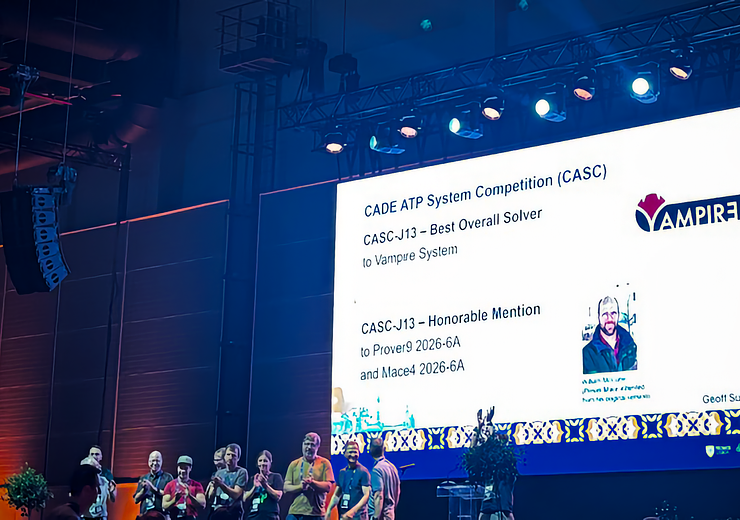
Big questions deserve high standards. Our award-winning research shows that we are pushing the limits. Here is what we have been working on.

Below is some of our recent work.
Want more?
Head over to our research unit pages!
Recent Projects
- 2022 – 2030 / Max-Planck-Gesellschaft zur Förderung der Wissenschaften
- 2022 – 2030 / Max-Planck-Gesellschaft zur Förderung der Wissenschaften / Publication
- 2026 – 2028 / Huawei Technologies Sweden AB
- 2025 – 2028 / Diligence Security Inc
- 2025 – 2028 / Austrian Research Promotion Agency (FFG) / Publications (2)
- 2023 – 2028 / European Commission / Publications (8)
- 2022 – 2028 / Christian Doppler Research Association (CDG) / Publications (60)
- 2026 – 2027 / SparxSystems Software GmbH
- 2026 – 2027 / Sui Foundation
- 2025 – 2027 / Ethereum Foundation / Publication
- 2024 – 2027 / Vienna Science and Technology Fund (WWTF) / Publications (6)
- 2024 – 2027 / Austrian Exchange Service (OeAD)
- 2024 – 2027 / Amazon Research Awards
- 2024 – 2027 / Austrian Science Fund (FWF) / Publication
- 2023 – 2027 / Austrian Research Promotion Agency (FFG) / Publications (2)
- 2007 – 2027 / Biber der Informatik / Website / Publication
- 2025 – 2026 / Austrian Research Promotion Agency (FFG)
- 2025 – 2026 / Magistrat der Stadt Wien MA 9 Wienbibliothek im Rathaus
- 2025 – 2026 / European Commission / Publications (2)
- 2024 – 2026 / FMA-Finanzmarktaufsicht
Recent Publications
- Stanisic, A., Gravara, M., Herrera Gonzalez, J. L., Nastic, S. (2027). Constella: A Novel Framework for Cost-Efficient Distributed AI Inference in LEO Space Data Centers. In M. Torquati, G. Mencagli, V. Cardellini, A. Antelmi, D. Medić (Eds.), Euro-Par 2026: Parallel Processing : 32nd European Conference on Parallel and Distributed Processing : Proceedings, Part II (pp. 347–362). Springer Cham. Peer-reviewed.DOI: 10.1007/978-3-032-35251-4_24 / Project: NexaSphere
- Pretel, E., Navarro, E., López-Jaquero, V., González-García, J. J., Dustdar, S. (2027). An Agent Design Pattern Catalogue for the Entanglement of Digital Twins. In A. Rio, J. Pereira dos Reis, S. Bibi, R. Machado (Eds.), Quality of Information and Communications Technology : 18th International Conference, QUATIC 2025, Lisbon, Portugal, September 3–5, 2025, Proceedings, Part I (pp. 3–18). Springer Cham. Peer-reviewed.
- Balau, V. A., Schnellmann, M., Proper, H. A. (2026). From Human-AI Task Allocation to Accountable Process Design : Modelling Concerns for Responsible Hybrid Intelligence. In E. Laurenzi, B. Re, H. F. Witschel (Eds.), Hybrid Intelligence in Business : 25th International Conference, BIR 2026, Olten, Switzerland, October 7–9, 2026, Proceedings (pp. 3–19). Springer Cham. Peer-reviewed.
- Walder, P., Schnellmann, M., Proper, H. A. (2026). On the Claimed Benefits of Enterprise Architecture Management. In E. Laurenzi, B. Re, H. F. Witschel (Eds.), Hybrid Intelligence in Business : 25th International Conference, BIR 2026, Olten, Switzerland, October 7–9, 2026, Proceedings (pp. 325–342). Springer Cham. Peer-reviewed.
- Melnyk, O., Huymajer, M., Jaud, Š., Huemer, C. (2026). IFC-for-Tunnelling schema extension: An evaluation of its impact on current BIM practices in the tunnelling domain. Tunnelling and Underground Space Technology, 176, Article 107838. Peer-reviewed.
- Fu, S., Dong, F., Xu, X., Shen, D., Bilal, M., Dustdar, S. (2026). CODEA: Online Container Deployment and Edge Association for Multi-Edge Federated Synergy Learning. IEEE Transactions on Mobile Computing, 25(10), 16275–16292. Peer-reviewed.
- Christakis, M., Isychev, A., Pilz, S., Tesarek, F., Wüstholz, V. (2026). Testing Static Taint Analyzers with Equivalence Modulo Taint. In Proceedings of the ACM on Software Engineering (pp. 3201–3222). Association for Computing Machinery. Peer-reviewed.DOI: 10.1145/3832231 / Project: MirandaTesting
- Furutanpey, A., Walser, C., Raith, P., Frangoudis, P. A., Dustdar, S. (2026). Leveraging Neural Graph Compilers in Machine Learning Research for Edge-Cloud Systems. IEEE Transactions on Parallel and Distributed Systems, 37(9), 2065–2077. Peer-reviewed.DOI: 10.1109/TPDS.2026.3708042 / Download: PDF
- Lackinger, A., Morichetta, A., Dustdar, S. (2026). Intent-Aware Multi-Domain Cloud Continuum Coordination through Hierarchical Deep Reinforcement Learning. In Proceedings 2026 IEEE 19th International Conference on Cloud Computing IEEE CLOUD 2026 (pp. 12–22). IEEE. Peer-reviewed.DOI: 10.1109/CLOUD72782.2026.00012 / Project: INTEND
- Gravara, M., Stanisic, A., Nastic, S. (2026). Design Methodology and Performance Trade-offs Management for Distributed and Compound AI Systems. In Proceedings of the IEEE 19th International Conference on Cloud Computing (IEEE CLOUD 2026) (pp. 376–387). IEEE. Peer-reviewed.DOI: 10.1109/CLOUD72782.2026.00049 / Project: NexaSphere
- Trimmel, F., Marcelino, C., Pusztai, T., Nastic, S. (2026). STORE: Self-Provisioning Storage-as-a-Service for Serverless Functions. In Proceedings of the 13th International Conference on Future Internet of Things and Cloud (FiCloud 2026) (pp. 185–192). IEEE. Peer-reviewed.
- Biffl, S., Bein, T., Kropatschek, S., Meixner, K., Lüder, A. (2026). SIAM DSL: Accessible Structured Text for Bridging the Architecture-Impact Gap in Cyber-Physical Production Systems. Works in Progress in Embedded Computing Journal (WiPiEC Journal), 12(2), 1–8. Peer-reviewed.DOI: 10.64552/wipiec.v12i2.148 / Project: PM4Analytics
- Watzinger, S., Wüstholz, V., Garg, D., Christakis, M. (2026). Cost-Effective Testing of MPC Compilers. Proceedings of the ACM on Software Engineering, 3(FSE), 4529–4550. Peer-reviewed.DOI: 10.1145/3808206 / Project: DK - AR
- Dustdar, S. (2026). Active Inference for Distributed Intelligence in the Computing Continuum. In Book of Abstracts of the 5th International Conference and Summer School Numerical Computations: Theory and Algorithms (NUMTA 2026) (pp. 25–25). Invited.HDL: 20.500.12708/229261
- Esterbauer, L., Thoma, M., Schwarzinger, T., Strasser, T. I., Kastner, W. (2026). Web of Things-Driven On-Device Automation for Resource-Constrained Energy Devices. In A. MAURI, L. Burgueño, R. TOMMASINI (Eds.), Web Engineering : 26th International Conference, ICWE 2026, Lyon, France, June 9–12, 2026, Proceedings (pp. 3–17). Springer Nature. Peer-reviewed.DOI: 10.1007/978-3-032-29372-5_1 / Project: ICBC
- Khilji, S. I., Furutanpey, A., Dustdar, S. (2026). Incentives and Evidence in Learned Service Orchestration. arXiv.DOI: 10.34726/12361 / Download: PDF
- Wang, Z., Sedlak, B., Herrera, J. L., Dustdar, S. (2026). Fair Comparison of Scheduling Algorithms on Heterogeneous Edge Clusters: A Continuous Adaptive Benchmark. arXiv.
- Mischak, M., Verbruggen, C., Langer, P., Bork, D. (2026). Uncovering LLM’s Capabilities in Model-Based Question Answering for UML Class Diagrams. In Enterprise, Business-Process and Information Systems Modeling : 26th International Conference, BPMDS 2025, and 30th International Conference, EMMSAD 2025, Vienna, Austria, June 16–17, 2025, Proceedings (pp. 331–348). Springer.DOI: 10.1007/978-3-032-28274-3_21 / Project: SmartGLSP
- Schnellmann, M., Proper, H. A. (2026). From Gut Feeling to Data-Driven Decisions. In L. Fuentes, P. Plebani, C. Combi, H. Reijers (Eds.), Advanced Information Systems Engineering : 38th International Conference, CAiSE 2026, Verona, Italy, June 8–12, 2026, Proceedings, Part I (pp. 3–21). Springer. Peer-reviewed.
- Sunaric, D., Verbruggen, C., Bork, D., Kappel, G. (2026). Vanilla-Converter: A Tool for Converting Camunda 7 BPMN Models into Camunda 8 Models. In Retrospective and Prospective Views on Information Systems Engineering (pp. 107–123). Springer. Peer-reviewed.
Recent Presentations
- Sedlak, B., Dustdar, S. (2026, June 29). Distributed Intelligence in the Computing Continuum 2 [Presentation]. 20th Symposium and Summer School on Service-Oriented Computing (SummerSoC 2026), Hersonissos, Greece. Invited.HDL: 20.500.12708/229650
- Dustdar, S., Sedlak, B. (2026, June 29). Distributed Intelligence in the Computing Continuum 1 [Presentation]. 20th Symposium and Summer School on Service-Oriented Computing (SummerSoC 2026), Hersonissos, Greece. Invited.HDL: 20.500.12708/229651
- Rauber, A. (2026, May 13). EOSC, EOSC nodes and services: What are they and how might they impact (help) us in doing our research? [Conference Presentation]. Open Science Day 2026, Wien, Austria. Invited.DOI: 10.34726/12205 / Download: PDF
- Dustdar, S. (2025, December 13). Active Inference for Distributed Intelligence in the Computing Continuum [Keynote Presentation]. International Conference of Intelligent and Knowledge-Based Systems (IKBS 2025), Nanchang, China. Invited.HDL: 20.500.12708/229369
- Dustdar, S. (2025, October 28). Active Inference for Distributed Intelligence in the Computing Continuum [Keynote Presentation]. 11th IEEE World Forum on Internet of Things (WF-IoT 2025), Chengdu, China. Invited.HDL: 20.500.12708/226606
- Dustdar, S. (2025, October 1). Active Inference for Distributed Intelligence in the Computing Continuum [Presentation]. National University of Singapore, Singapore, Singapore. Invited.HDL: 20.500.12708/227858
- Rippberger Fonseca, M. D. L. A. G. A., Neidhardt, J. (2025, September 22). Comparative Analysis of Fashion Captioning for Multimodal Fashion Recommendation [Conference Presentation]. 19th ACM Conference on Recommender Systems (RecSys ’25), Prag, Czechia.HDL: 20.500.12708/226348
- Dustdar, S. (2025, September 16). Active Inference for Distributed Intelligence in the Computing Continuum [Keynote Presentation]. 20th Conference on Computer Science and Intelligence Systems (FedCSIS 2025), Krakow, Poland. Invited.HDL: 20.500.12708/219809
- Dustdar, S. (2025, September 10). Active Inference for Distributed Intelligence in the Computing Continuum [Keynote Presentation]. JCIS 2025 at SISTEDES 2025, Cordoba, Spain. Invited.HDL: 20.500.12708/219805
- Dustdar, S. (2025, August 14). Active Inference for Distributed Intelligence in the Computing Continuum [Keynote Presentation]. 27th IEEE International Conference on High Performance Computing and Communications (HPCC 2025), Exeter, United Kingdom of Great Britain and Northern Ireland (the). Invited.HDL: 20.500.12708/227074
- Dustdar, S. (2025, August). Active Inference for Distributed Intelligence in the Computing Continuum Image [Keynote Presentation]. 3rd International Conference on The Frontiers of Robotics and Software Engineering (FRSE 2025), Zhangjiajie, China.HDL: 20.500.12708/224055
- Pachinger, P., Planitzer, A. M., Neidhardt, J., Hanbury, A., Lecheler, S. (2025, August 1). Alignment by Disagreement? Toward Investigating LLMs’ Adaptation to Personal and Sociodemographic Variability in the Perception of Toxicity [Conference Presentation]. The 9th Workshop on Online Abuse and Harms (WOAH), Wien, Austria.
- Christakis, M. (2025, July 15). Just Nail It: Systematic Testing for Complex Systems [Conference Presentation]. CISPA Technical talks, Saarbrücken, Germany. Invited.HDL: 20.500.12708/218106
- Dustdar, S. (2025, June 21). Active Inference for Distributed Intelligence in the Computing Continuum Image [Keynote Presentation]. 16th International Conference on Internetware (Internetware 2025), Trondheim, Norway. Invited.HDL: 20.500.12708/219808
- Christakis, M. (2025, June 10). Just Nail It: Systematic Testing for Complex Systems [Conference Presentation]. MPI-SWS Research Symposium, Germany.HDL: 20.500.12708/217207
- Pachinger, P., Planitzer, A. M., Lecheler, S., Neidhardt, J., Hanbury, A., Wegener, R. (2025, April 25). A Perspectivist Approach to Content Moderation: Incorporating User Perceptions of Online Norm Violations in Toxicity Detection Models [Conference Presentation]. 7th ANNUAL COMPTEXT Conference 2025, Wien, Austria.
- Flicker, K., Blumesberger, S., Rey Mazón, M., Czuray, M., Saurugger, B. (2025, April 1). Datennutzung - Perspektiven aus dem Forschungsalltag in Österreich [Conference Presentation]. 2. Österreichischer Bibliothekskongress, Vienna, Austria.
- Dustdar, S. (2025, March 3). Active Inference in Distributed Computing Continuum Systems [Presentation]. RCIS 2025 Workshop, Valencia, Spain. Invited.HDL: 20.500.12708/215825
- Christakis, M. (2025, February 24). Interrogation Testing of Program Analyzers for Soundness and Precision Issues [Presentation]. 70th IFIP WG2.4 Meeting on Software Implementation Technology, Singapore, Singapore.HDL: 20.500.12708/214049
- Dustdar, S. (2025, February 14). Active Inference for Distributed Intelligence in the Computing Continuum [Keynote Presentation]. ASPIRE×PRESTO Workshop, Muroran, Japan. Invited.HDL: 20.500.12708/216887
Recent Theses
- Furutanpey, A. (2026). Efficient Transmission and Recovery of Salient Information [Dissertation, Technische Universität Wien]. reposiTUm.DOI: 10.34726/hss.2026.128724 / Download: PDF
- Stromberger, A. M. K. (2026). Validating solidity compilers via assertion-driven metamorphic testing [Diploma Thesis, Technische Universität Wien]. reposiTUm.
- Jakubowicz-Schroll, D. P. (2026). Design and valuation of a digital gamified learning platform for 3D software education [Diploma Thesis, Technische Universität Wien]. reposiTUm.DOI: 10.34726/hss.2026.133207 / Download: PDF
- Ranzinger, M. (2026). A systematic comparison of named entity recognition approaches for cyber threat intelligence [Diploma Thesis, Technische Universität Wien]. reposiTUm.DOI: 10.34726/hss.2026.131901 / Download: PDF
- Kitzberger, G. (2026). An architecture for web-based distributed LLM inference [Diploma Thesis, Technische Universität Wien]. reposiTUm.DOI: 10.34726/hss.2026.138985 / Download: PDF
- Kitzberger, G. (2026). Optimizing distributed LLM inference for heterogeneous workers through dynamic graph partitioning [Diploma Thesis, Technische Universität Wien]. reposiTUm.DOI: 10.34726/hss.2026.138984 / Download: PDF
- Mischak, M. (2026). Accessibility in model engineering : large model comprehension and auditory conversational agents [Diploma Thesis, Technische Universität Wien]. reposiTUm.DOI: 10.34726/hss.2026.124560 / Download: PDF
- Djelic, A. (2026). Data-centric AI for conceptual modeling : cleansed data and a GNN-LLM based recommender for UML class diagrams [Diploma Thesis, Technische Universität Wien]. reposiTUm.DOI: 10.34726/hss.2026.133242 / Download: PDF
- Sepin, S. (2026). Evaluating the impact of faults on the quality of service of edge-cloud applications [Diploma Thesis, Technische Universität Wien]. reposiTUm.DOI: 10.34726/hss.2026.133116 / Download: PDF
- Sederl, J. (2026). Cross-blockchain data storage [Diploma Thesis, Technische Universität Wien]. reposiTUm.DOI: 10.34726/hss.2026.76200 / Download: PDF
- Pavlovic, D. (2026). Bias in medical recommendations : prompting vs. fine-tuning of large language models [Diploma Thesis, Technische Universität Wien]. reposiTUm.DOI: 10.34726/hss.2026.131812 / Download: PDF
- Weber, J. (2026). A learning-driven zero trust framework for evaluating lightweight intrusion detection models on WebAssembly [Diploma Thesis, Technische Universität Wien]. reposiTUm.DOI: 10.34726/hss.2026.131924 / Download: PDF
- Tcapnikova, M. (2026). Designing an AI-based personal sales advisor for fashion retail : a human-AI task allocation framework [Diploma Thesis, Technische Universität Wien]. reposiTUm.DOI: 10.34726/hss.2026.138722 / Download: PDF
- Hell, A. (2026). Design and implementation of a model context protocol (MCP) server for the graphical language server platform (GLSP) [Diploma Thesis, Technische Universität Wien]. reposiTUm.DOI: 10.34726/hss.2026.137296 / Download: PDF
- Maresch, M. (2026). Distributed training of deep learning models in the edge-cloud-space continuum [Diploma Thesis, Technische Universität Wien]. reposiTUm.DOI: 10.34726/hss.2026.136960 / Download: PDF
- Arcanjo Marcelino, C. K. (2026). Performance Engineering for the Next-Generation of Serverless Computing [Dissertation, Technische Universität Wien]. reposiTUm.DOI: 10.34726/hss.2026.127443 / Download: PDF
- Schmiedmayer, M. (2026). The impact of using large language models on the performance of conversational recommender systems [Diploma Thesis, Technische Universität Wien]. reposiTUm.DOI: 10.34726/hss.2026.118745 / Download: PDF
- Winterleitner, F. (2026). Evaluation the state of common data environment software for BIM projects [Diploma Thesis, Technische Universität Wien]. reposiTUm.DOI: 10.34726/hss.2026.103110 / Download: PDF
- Kurz, M. (2026). EdgeSync : local-first inference for LLMs in edge-cloud environments [Diploma Thesis, Technische Universität Wien]. reposiTUm.DOI: 10.34726/hss.2026.127302 / Download: PDF
- Schnabl, V. (2026). Multi-model business intelligence exploration for monitoring and improving institutional reporting [Diploma Thesis, Technische Universität Wien]. reposiTUm.DOI: 10.34726/hss.2026.139329 / Download: PDF
We shape the future.
The next generation of information systems will be more autonomous, and more deeply woven into society. We are positioned to tackle the challenges this creates: making AI-driven systems verifiable and transparent, orchestrating resilient infrastructures, enabling seamless interoperability. We are working on trustworthy data ecosystems, secure sharing, provenance and regulatory compliance. With our research, we aim to strengthen Europe’s competitiveness and create lasting economic value.



Want more? We have more. Head over to our Newsroom!