
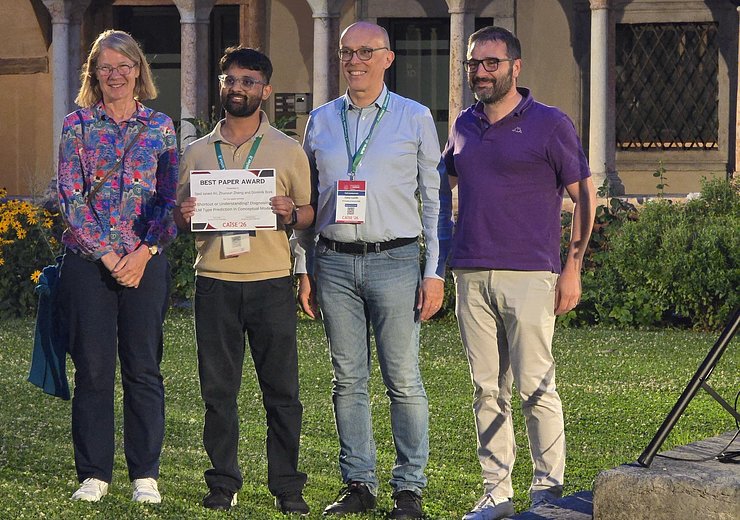
Best Paper Award at CAiSE 2026!
We’re excited to announce that the paper “Shortcut or Understanding? Diagnosing LLM Type Prediction in Conceptual Models” received a Best Paper Award at CAiSE!

Picture: Dominik Bork, Syed Juned Ali, Zhuoxun Zheng
We’re excited to announce that Syed Juned Ali, Zhuoxun Zheng, and Dominik Bork — all three from our Research Unit Business Informatics — have won a Best Paper Award at the 38th International Conference on Advanced Information Systems Engineering for their paper “Shortcut or Understanding? Diagnosing LLM Type Prediction in Conceptual Models”!
Automated type prediction has become an important capability of intelligent assistants for conceptual modeling, but it remains unclear which types of information these systems rely on most. Shortcut or Understanding? Diagnosing LLM Type Prediction in Conceptual Models explores how natural language descriptions, model structure, and different AI approaches affect prediction quality. Using conceptual models from enterprise architecture and OntoUML, the authors compare language model–based methods under different levels of available semantic and structural information. The findings show that meaningful labels play the most important role, while structural information can improve predictions when labels are incomplete or missing. The results also provide guidance for developing more effective AI-supported conceptual modeling tools in the future.
The International Conference on Advanced Information Systems Engineering (CAiSE) is a premier venue for advancing both the theoretical foundations and practical applications of information systems and enterprise engineering. The conference is widely recognized for showcasing high-quality research on topics such as business process management, enterprise architecture, requirements engineering, digital transformation, data and knowledge management, artificial intelligence in information systems, and socio-technical systems. By fostering collaboration between academia and industry, CAiSE plays a significant role in shaping the future of information systems engineering and addressing emerging challenges in the digital economy, public services, and modern enterprises.
Congratulations to Syed, Zhuoxun, and Dominik on this outstanding achievement!



Abstract
Automated type prediction in conceptual models—such as ArchiMate and OntoUML—has emerged as a core capability of modern intelligent modeling assistants. Yet it remains unclear whether these systems genuinely leverage the semantic and structural richness of conceptual models or merely exploit surface-level regularities in modeling repositories. This paper presents a systematic investigation into how natural language labels, structural context, and different learning paradigms shape type-semantics prediction. Using a controlled dataset-generation pipeline, we create parametrized text datasets from large collections of enterprise architecture and OntoUML models by manipulating label semantics and structural context. We evaluate two contrasting families of approaches—pretrained BERT models finetuned for masked and supervised classification, and prompting-based LLMs using zero-shot and few-shot strategies. Our results indicate that natural language semantics are the primary driver of predictive performance, with structural cues providing complementary support only when meaningful labels are intact. Finetuned BERT models outperform LLM prompting when label quality degrades but structural regularities remain available, whereas prompting with local few-shot examples becomes highly competitive under severe label sparsity. These findings offer empirical guidance for future intelligent modeling assistants that would utilize hybrid architectures that combine structurally trained encoders with LLM-based semantic reasoning.
About the authors
Syed Juned Ali is a predoctoral researcher at the Research Unit [Business Informatics](https://informatics.tuwien.ac.at/orgs/e194-03 at TU Wien Informatics. He received his B.Tech and MSc in Computer Science from the International Institute of Information Technology, Hyderabad, India, and his PhD at TU Wien Informatics. His research lies at the intersection of conceptual modeling, machine learning, and generative artificial intelligence, with a particular focus on Large Language Models (LLMs), Retrieval-Augmented Generation (RAG), Graph Neural Networks (GNNs), and knowledge graph-based representation learning. His current research focuses on industry collaboration and on developing intelligent systems that leverage structured knowledge and language models to support enterprise decision-making and software engineering tasks. His work has been published at leading conferences, including CAiSE, ER, and MODELS.
Dominik Bork is an Associate Professor and Head of the Research Unit Business Informatics at TU Wien Informatics. Prior to joining TU Wien, he worked as a postdoctoral researcher at the University of Vienna. He received his Diploma in Information Science and his PhD (Dr. rer. pol.) from the University of Bamberg, where his research focused on multi-view enterprise modeling and metamodeling. Throughout his academic career, he has been a visiting researcher and active collaborator with several internationally renowned institutions, including the University of Technology Sydney, the Instituto Tecnológico Autónomo de México, the University of Pretoria, Stockholm University, and the École des Mines d’Albi. He also serves as an elected domain expert of the Special Interest Group on Modeling Business Information Systems of the German Informatics Society (GI).
Zhuoxun Zheng is a postdoctoral researcher at the Research Unit Business Informatics at TU Wien Informatics. He received his MSc in mechanical engineering from the Karlsruhe Institute of Technology in Germany and his PhD in Informatics from the University of Oslo. His research focuses on knowledge graphs, retrieval-augmented generation, graph-based reasoning, and recommender systems. His interests lie in building intelligent systems that combine structured data, machine learning, and large language models to support reliable retrieval, reasoning, and decision-making. He is particularly interested in enterprise knowledge graphs, GraphRAG, LLM agents, recommender systems, and AI-assisted decision support. His work has been published in ICWC, ESWC, and KDD, among others.
Curious about our other news? Subscribe to our news feed, calendar, or newsletter, or follow us on social media.