
Best Student Paper Awards at ICLP 2026 and LPNMR26!
We are excited to announce that two student papers have received awards at major international conferences in logic programming!
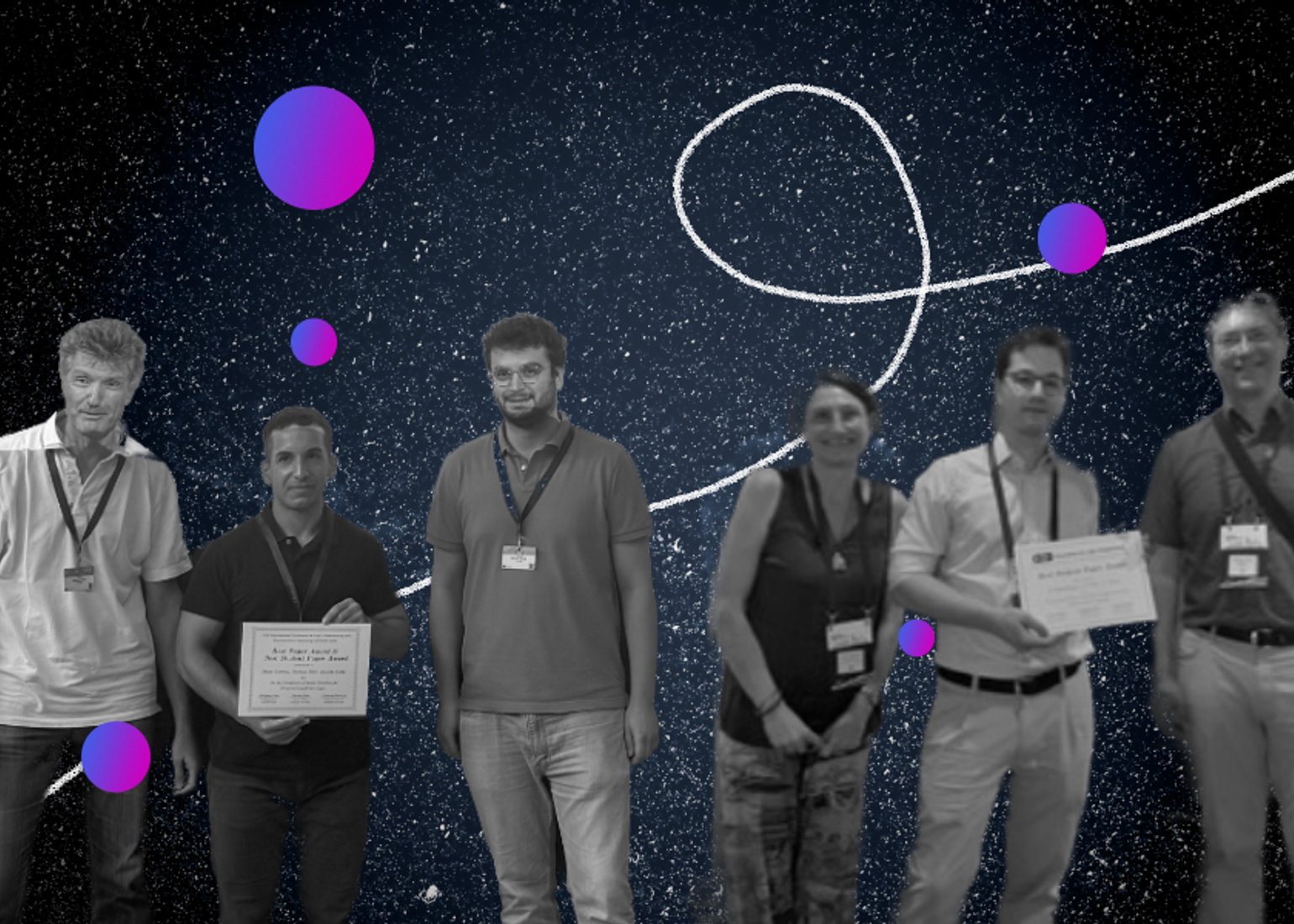
Picture: (right) Daniela Inclezanl
At the 18th International Conference on Logic Programming and Non-monotonic Reasoning (LPNMR 2026), Oscar Barreca, Thomas Eiter, and Davide Soldà received the Best Paper Award and the Best Student Paper Award for their paper, “On the Complexity of Model Checking for Temporal Equilibrium Logic”. At the 42nd International Conference on Logic Programming (ICLP 2026), Rafael Bankosegger, Thomas Eiter, and Johannes Oetsch received the Best Student Paper Award for their paper, “Answer-Set-Programming-based Abstractions for Reinforcement Learning”.
Both publications emerged from master’s thesis research conducted at TU Wien. Congratulations to Davide, Johannes, Rafael, Oscar, and Thomas on these outstanding achievements!
Best Paper & Best Student Paper Award at LPNMR
At the 18th International Conference on Logic Programming and Non-monotonic Reasoning (LPNMR 2026), Oscar Barreca, Thomas Eiter, and Davide Soldà received the Best Paper Award and Best Student Paper Award for their paper, “On the Complexity of Model Checking for Temporal Equilibrium Logic”.
Abstract: Given an interpretation I and a formula 𝜑 written in a logic L, the problem of model checking (MC) for L is the problem of determining whether I is a model of 𝜑. In this work, the computational complexity of MC for temporal equilibrium logic (TEL), a temporal extension of ASP, is investigated. The complexity of the universal and the existential variant of MC for TEL over Kripke structures, and of MC over linear traces, is determined. The complexity of these problems when the set of temporal operators, the temporal height or the implication height of the input formula is restricted is also determined.
LPNMR is an international forum for exchanging ideas on declarative logic programming, non-monotonic reasoning, and knowledge representation. Its 18th edition was held in Klagenfurt, Austria. The aim of the conference is to facilitate interactions between researchers and practitioners interested in the design and implementation of logic-based programming languages and database systems, and those working in knowledge representation and nonmonotonic reasoning. LPNMR strives to encompass theoretical and experimental studies that have led or will lead to advances in declarative programming and knowledge representation, as well as their use in practical applications.
Best Student Paper Award at ICLP 2026
At the 42nd International Conference on Logic Programming (ICLP 2026), Rafael Bankosegger, Thomas Eiter, and Johannes Oetsch received the Best Student Paper Award for their paper, “Answer-Set-Programming-based Abstractions for Reinforcement Learning”.
Abstract: Reinforcement Learning (RL) enables autonomous agents to learn policies from experience, but realistic problems often involve enormous state spaces, making learning and generalisation challenging. Abstraction and approximation are therefore essential. Relational Reinforcement Learning (RRL) offers a way to reason about objects and their relations, and the CARCASS framework by Martijn van Otterlo demonstrates how logical representations can model Markov Decision Processes (MDPs) in first-order domains. Originally implemented in Prologue, CARCASS leverages domain knowledge to create powerful abstractions. We explore Answer-Set Programming (ASP), which is a rich and, contrary to Prologue, fully declarative modelling language, to realise CARCASS abstractions. We evaluate our ASP-based implementation in case studies of two domains, viz. Blocks World and Minigrid. Our results indicate that CARCASS with ASP provides a promising approach to constructing abstractions for RL, especially when domain knowledge is available.
ICLP: The International Conference on Logic Programming (ICLP) is the leading academic conference for research in logic programming. The 42nd edition was held at ISCTE – Instituto Universitário de Lisboa in Lisbon, Portugal, as part of the Federated Logic Conference (FLoC 2026). It spans topics such as formal and operational semantics, non-monotonic reasoning, knowledge representation, and complexity. It also addresses program analysis and optimization, focusing on verification, debugging, and logic-based validation. Held annually and organized by the Association for Logic Programming (ALP), the conference features peer-reviewed papers, with post-proceedings published in the Theory and Practice of Logic Programming (TPLP) journal. Acceptance for papers at ICLP is highly selective, with only about 20% of submissions accepted for publication in the TPLP journal.
Curious about our other news? Subscribe to our news feed, calendar, or newsletter, or follow us on social media.