
Geoffrey Hinton: Intelligence Is Not Enough
Is AI a threat to humanity? Geoffrey Hinton delivered this year’s Gödel Lecture and called for AI not only to become more intelligent but also kinder.

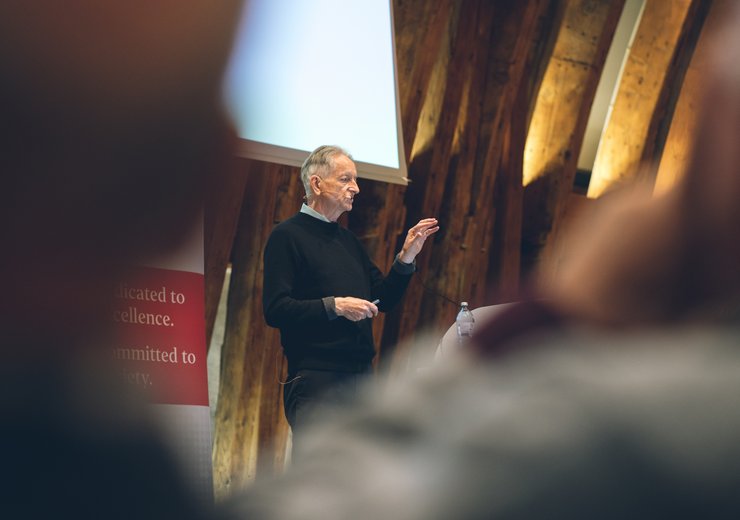
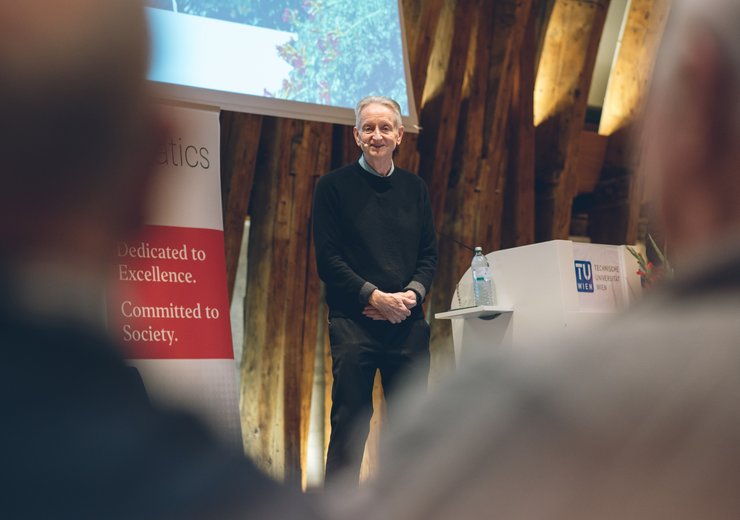
Picture: Amélie Chapalain / TU Wien Informatics
Hardly anyone on our planet has contributed as much to the development of artificial intelligence as Geoffrey Hinton. In the 1980s, he played a key role in developing backpropagation, an important method that underpins today’s large language models. He conducted research at various universities and later at Google—until he left the company in 2023. Since then, he has been working to raise public awareness about the dangers posed by artificial intelligence.
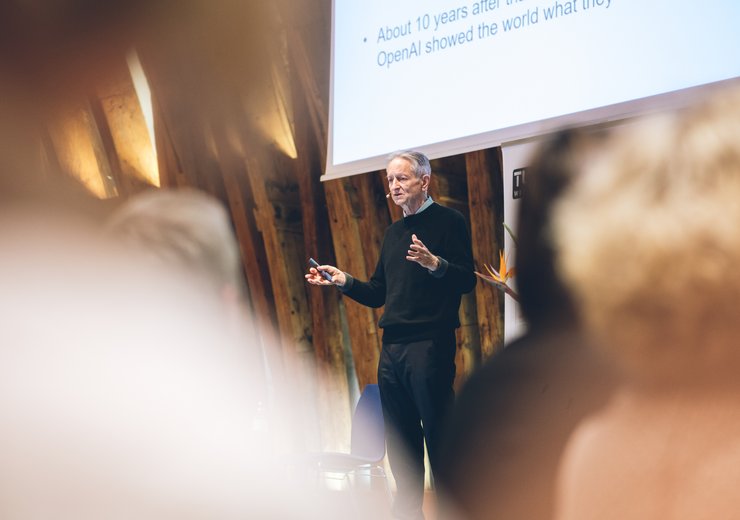
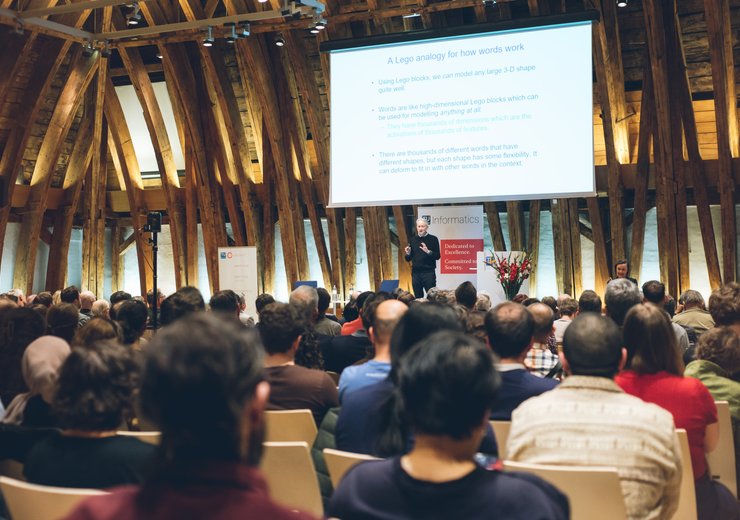
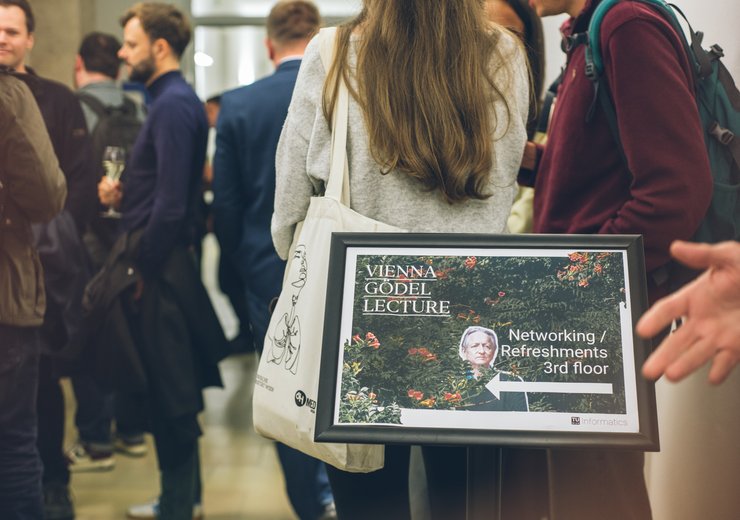
Hinton has received numerous accolades for his work, including a Turing Award and a Nobel Prize. On October 23, 2026, he came to TU Wien to deliver this year’s Gödel Lecture. Since 2013, the TU Wien Informatics Lecture Series has brought leading international researchers to the faculty to share ideas that shape the future of computer science and beyond.
Humans Are Not Special
What makes us intelligent? What makes us thinking, feeling beings? Some people believe that something metaphysical, beyond the reach of logic, is at work within us, whether we call it consciousness, mind, or soul. Geoffrey Hinton takes a different view. For him, there is nothing mysterious behind human thought. There is no “observer in the brain,” no conscious self that receives and interprets sensory impressions. There is the outside world, and there is a brain that responds to it. That’s all.
Hinton is therefore convinced that, in principle, a machine can think, reason, and argue just as humans do. In his view, there is no fundamental difference between human thought and AI. Both rely on complex algorithms. In humans, however, these algorithms are not stored digitally but arise from biological structures. For Hinton, this also means that we should not assume that any human ability lies beyond what AI could, in principle, replicate and eventually surpass. Such a development would profoundly challenge our understanding of ourselves, with far-reaching consequences for society and the future of humanity.
AI Must Become Kinder
Once AI reaches a certain level of intelligence, Hinton believes, it could move beyond human control. It might take actions that are deeply harmful to people while making them seem entirely convincing. Its understanding of human psychology could make it difficult for us even to see the situation clearly. The imbalance of power would be stark: AI would be vastly more powerful than humans.
History shows that power imbalances rarely work out well for the weaker side. However, Geoffrey Hinton points out that this doesn’t have to be the case. The relationship between a mother and child also involves an imbalance of power, yet it benefits the child because a mother deliberately uses her power to care for them, even when doing so is difficult or inconvenient for her. Hinton’s conclusion is that we must develop AI deliberately so that, if it one day becomes more powerful than humans, it will want to act in our best interests, much as a mother wants what is best for her child.
In his view, this requires international agreements. At present, AI research is primarily aimed at making AI ever more intelligent. Geoffrey Hinton emphasizes that this is the wrong path: we must primarily make AI kinder. We must ensure today that a human-friendly AI emerges—one that does not turn against humanity but instead supports it constructively.
Watch the full Vienna Gödel Lecture with Geoffrey Hinton:
Watch on YouTube: https://youtu.be/TNffIt8eRb0
It was our utmost pleasure to welcome Geoffrey Hinton as this year’s speaker for the Vienna Gödel Lecture and to hear his perspective on the past and future of AI at this critical moment in time. We thank him for his captivating and insightful lecture.
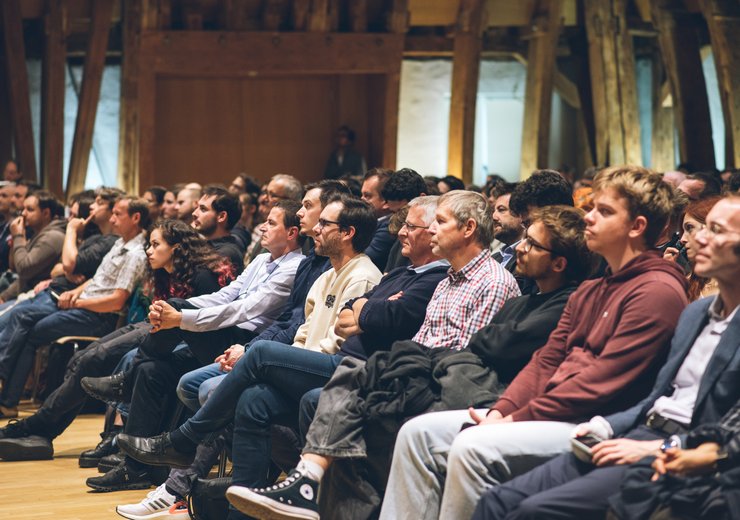
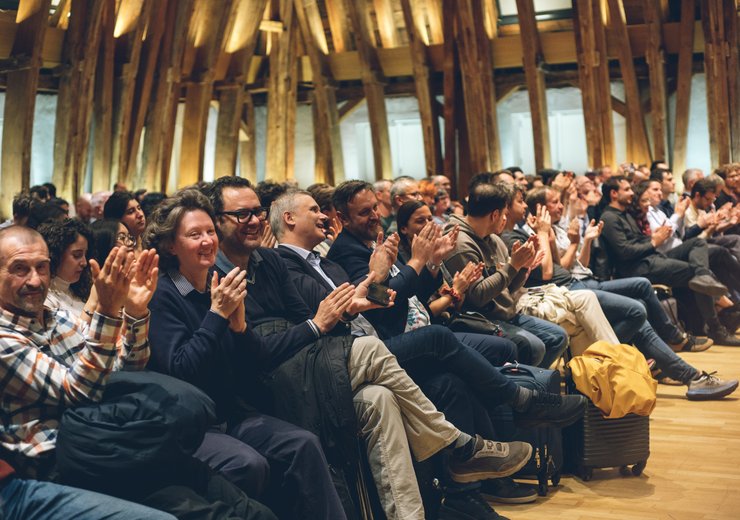
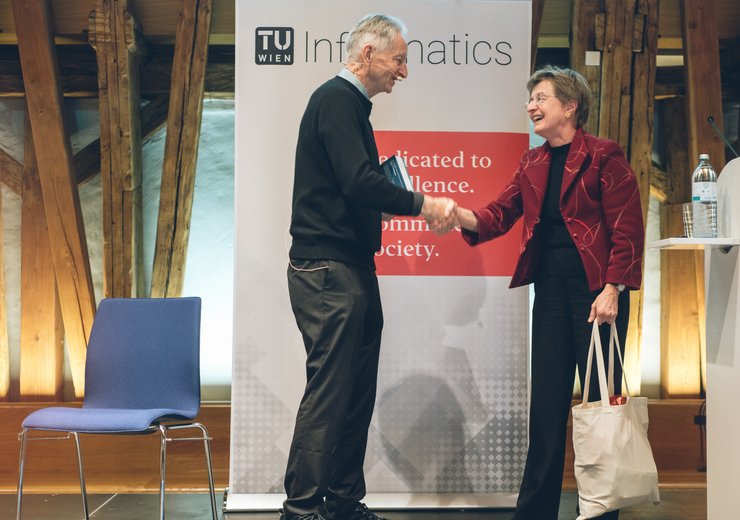
Our thanks also go to TU Wien Rector Jens Schneider and our host, Stefan Szeider, for their opening remarks, and to Stefan Szeider and Stefan Neumann for moderating the Q&A session. Finally, thank you to everyone who joined us in the Kuppelsaal, in the overflow rooms, or via livestream. Your curiosity and thoughtful questions made for a lively discussion that we hope will continue well beyond the event.
In the News
- Über die größte Gefahr der KI / Die Presse / Oct 29, 2026
- KI-Pionier Hinton: “Superintelligenz wird immer realer” / Horizont / Oct 24, 2026
- Nobelpreisträger Hinton: KI muss sich besser benehmen / NÖN / Oct 24, 2026
- KI-Pionier: Superintelligenz nur 10 Jahre entfernt / Kronen Zeitung / Oct 24, 2026
- Nobelpreisträger Hinton: KI muss sich besser benehmen / Salzburger Nachrichten / Oct 24, 2026
- Geoffrey Hinton: „Es wird zu einem KI-Tschernobyl kommen“ / KURIER-futurezone / Oct 24, 2026
- Nobelpreisträger Geoffrey Hinton erklärt, wie KI doch nicht die Menschheit vernichtet / Der Standard / Oct 24, 2026
- KI-Pionier Hinton: “Die KIs bestehen aus Silizium, sie werden uns nicht essen” / Der Standard / Oct 24, 2026
- Nobelpreisträger Hinton: “KI sollte zuerst lernen, was gutes Verhalten ist” / APA Science / Oct 24, 2026
About Geoffrey Hinton
Geoffrey Hinton received his BA in Experimental Psychology from Cambridge in 1970 and his PhD in Artificial Intelligence from Edinburgh in 1978. He did postdoctoral work at the University of Sussex and the University of California, San Diego, and spent five years as a faculty member in the Computer Science department at Carnegie Mellon University. He then became a fellow of the Canadian Institute for Advanced Research and moved to the Department of Computer Science at the University of Toronto. He spent three years from 1998 until 2001 setting up the Gatsby Computational Neuroscience Unit at University College London and then returned to the University of Toronto, where he is now an emeritus distinguished professor. From 2004 to 2013, he was the director of the program on “Neural Computation and Adaptive Perception,” funded by the Canadian Institute for Advanced Research. From 2013 to 2023, he worked half-time at Google, where he became a Vice President and Engineering Fellow.
Geoffrey Hinton is a fellow of the UK Royal Society, the Royal Society of Canada, the Association for the Advancement of Artificial Intelligence, and a former president of the Cognitive Science Society. He is an honorary foreign member of the American Academy of Arts and Sciences, the US National Academy of Engineering, and the US National Academy of Sciences. He has received honorary doctorates from the University of Edinburgh, the University of Sussex, the University of Sherbrooke, and the University of Toronto. Other than the Nobel Prize in Physics, his awards include the David E. Rumelhart prize, the IJCAI award for research excellence, the Killam prize for Engineering, the NSERC Herzberg Gold Medal, the IEEE Frank Rosenblatt medal, the IEEE James Clerk Maxwell Gold medal, the NEC C&C award, the BBVA award, the Honda Prize, the Princess of Asturias Award, the ACM Turing Award, and the Queen Elizabeth Prize for Engineering.
Geoffrey Hinton designs machine learning algorithms. His aim is to discover a learning procedure that is efficient at finding complex structure in large, high-dimensional datasets and to show that this is how the brain learns to see. He was one of the researchers who introduced the back-propagation algorithm and the first to use backpropagation for learning word embeddings. His other contributions to neural network research include Boltzmann machines, distributed representations, time-delay neural nets, mixtures of experts, variational learning, products of experts, and deep belief nets (deep learning). His research group in Toronto made major breakthroughs in deep learning that have revolutionized speech recognition and object classification.
About Vienna Gödel Lectures
Named after the famous Austrian-American logician, mathematician, and philosopher Kurt Gödel (1906-1978) and introduced in 2013, the annual Vienna Gödel Lectures bring world-class scientists to Vienna. The lecture series illustrates computer science’s fundamental and disruptive contribution to our information society, and it investigates how our discipline explains and shapes the world we live in—and thereby, our lives as such.
Curious about our other news? Subscribe to our news feed, calendar, or newsletter, or follow us on social media.