
What Drives Conflict in Social Networks?
Accepted at NeurIPS 2025, this paper uncovers how a few clear opinion intervals can explain conflicts in online and political networks.
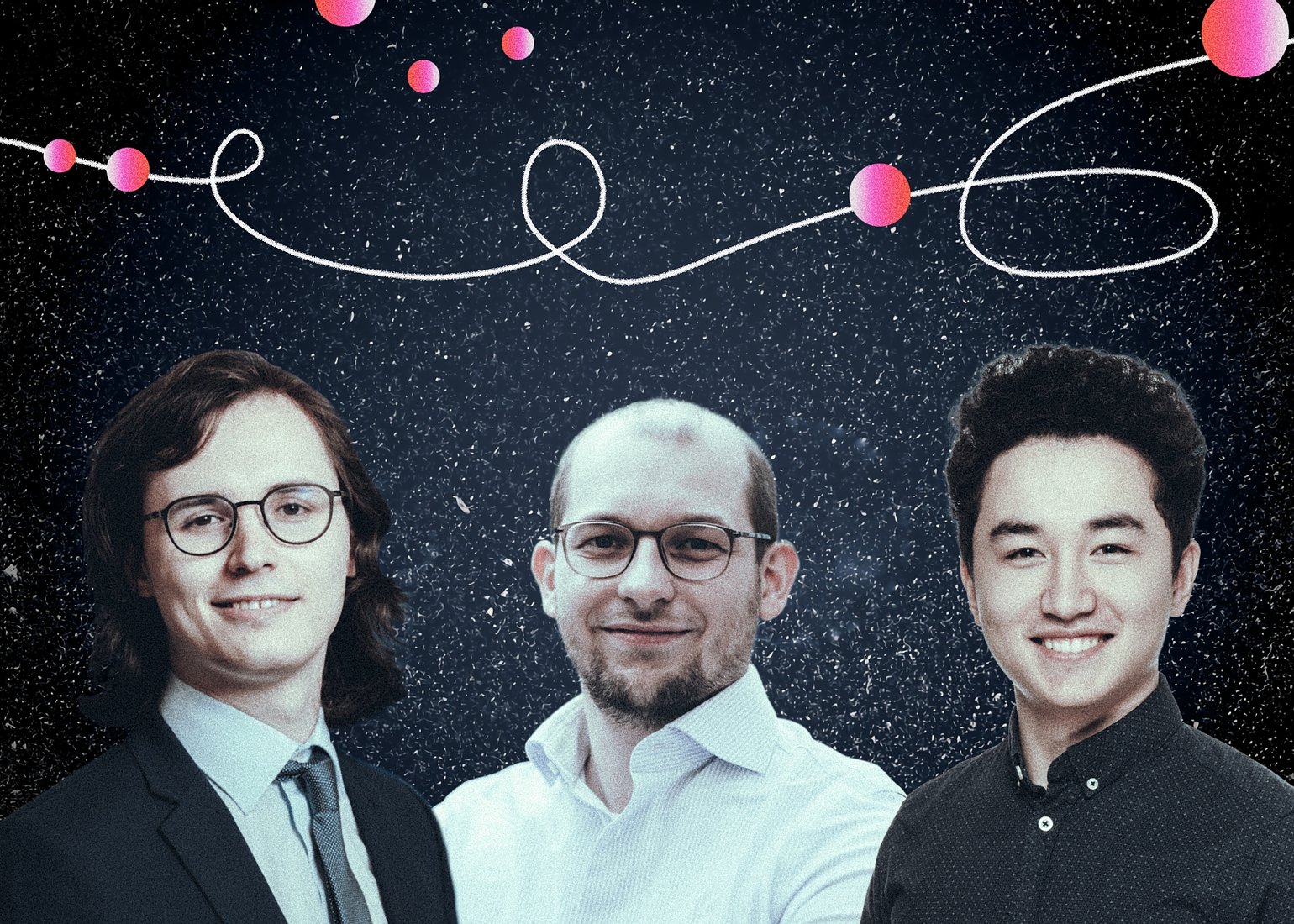
Picture: Klaus Ranger, Amélie Chapalain, and Zsolt Marton
We’re delighted to announce that the paper Discovering Opinion Intervals from Conflicts in Signed Graphs was accepted for presentation at NeurIPS 2025! The paper was written by Peter Blohm, Florian Chen, Stefan Neumann, and Aristides Gionis (KTH).
The paper investigates how conflicts in online social networks can be explained by a small and interpretable set of underlying opinion ranges. While social media platforms enable people to share opinions and discuss current events, disagreements and conflicts naturally arise. In the paper, the authors explore whether these conflicts can be explained by a small number of clear opinion ranges that shape how people interact. The study presented in the paper models social interactions as a network with positive and negative links, representing friendly and hostile relationships, and aims to assign users to opinion intervals consistent with these interactions. This task is formulated as an optimization problem, with its computational challenges analyzed and efficient approximation methods developed based on related graph problems. Practical algorithms are proposed that scale well and produce more informative results than standard approaches, and a case study using voting data from the German parliament demonstrates the method’s ability to uncover meaningful political positions of parties.
NeurIPS (The Conference and Workshop on Neural Information Processing Systems) is a leading conference in machine learning and computational neuroscience, recognized as one of the three most influential forums in artificial intelligence research. The paper was accepted for oral presentation at NeurIPS 2025 as one of only 77 out of 5,290 accepted papers from a total of 21,575 submissions. This distinction highlights the paper’s exceptional quality and its standing among a highly competitive set of contributions.
Congratulations on this excellent achievement, Peter, Florian, Stefan, and Aristides Gionis!
About the Authors
Peter Blohm
Peter Blohm is a research assistant in the Quantum Machine Learning Group at Aalto University, led by Asst. Prof. Vikas Garg. During this extended internship, he is working on ensembling techniques for diffusion models, which enhance their ability to solve combinatorial problems. In May 2025, he completed his master’s studies in Logic and Computation at TU Wien Informatics. His thesis, supervised by Thomas Gärtner, investigated probabilistic verification methods, specifically how to obtain probabilistic safety guarantees from complex black-box systems through randomized testing. Alongside his studies, he worked as a student employee at the Research Unit Machine Learning, where he was supervised by Stefan Neumann. Together with Florian Chen, he investigated the discovery of opinions in social networks.
Florian Chen
Florian Chen is a master’s student in Advanced Computer Science at the University of Oxford. Previously, he completed his bachelor’s degree in Software & Information Engineering at TU Wien Informatics. Alongside his studies, Florian worked as a student employee at the Research Unit Machine Learning, where he was supervised by Stefan Neumann and Thomas Gärtner. His research there focused on algorithms for interactive data visualization, generalization properties in statistical relational learning models, and the discovery of opinions in social networks.
Both Florian and Peter completed the faculty’s Bachelor with Honors program, an excellence initiative that allows students to showcase their potential through individually tailored challenges, cultivate their talents, and actively engage in scientific research.
Stefan Neumann
Stefan Neumann is an Assistant Professor at the Research Unit Machine Learning at TU Wien Informatics, where a WWTF VRG Grant partly funds his research activities. He is an expert in data science and social network analysis. In data science, his work involves creating reliable algorithms, focusing on theoretical methods that identify and utilize data patterns. In social network analysis, Stefan Neumann examines the effects of specific interventions, like Facebook’s timeline algorithm, on network polarization and disagreement. Before his current role, he was a postdoctoral researcher and a tenure-track Assistant Professor at KTH, working in the group of Aristides Gionis. He earned his PhD from the University of Vienna under the supervision of Monika Henzinger and spent six months as a visiting researcher at Brown University with Eli Upfal. The Austrian Computer Society honored his PhD thesis with the Heinz Zemanek Award, and he received the Award of Excellence from the Austrian federal government. His academic foundation was laid at Saarland University and the Max Planck Institute for Informatics, where he earned his master’s degree, collaborating with Pauli Miettinen and Jilles Vreeken.
Curious about our other news? Subscribe to our news feed, calendar, or newsletter, or follow us on social media.