
Master Medical Informatics
From code to care—if you want to improve clinical workflows, visualize medical research, and develop software that supports patient care, then this joint master’s program by TU Wien Informatics and Medical University of Vienna is exactly what you’re looking for!
Facts
- Duration: 4 Semesters
- ECTS: 120
- Degree: Dipl.-Ing. (equivalent to MSc)
- Language: English
- Curriculum: German (official) / English
- Courses: TU Wien / MedUni
- Questions? — We have answers
Diese Seite in Deutsch.
About
Whether you’re fascinated by medical innovations or want to improve patient outcomes through intelligent technologies: Our master’s program Medical Informatics combines technical and medical knowledge to tackle real-world health challenges. You’ll build expertise in AI & machine learning, medical data science, computer vision and software engineering while gaining a deep understanding of clinical practice and biological principles. This joint master’s program by TU Wien Informatics and Medical University of Vienna prepares you to drive innovation in healthcare, no matter if you want to pursue an academic career or venture into the health sector.
What to expect?
We build from the basics: You’ll gain a solid understanding of medical data science, digital health, software engineering, biology, and clinical workflows before exploring advanced topics tailored to your interests. Throughout the program, you’ll learn how to analyze complex biomedical data, develop intelligent health technologies, and build interoperable digital systems for clinical and research environments. Five specializations offer deeper knowledge in your favored field of interest: Bioinformatics; Neuroinformatics; Public Health Informatics; Mobile Health, Wearable, and Assistive Technologies; AI and Analytics in Clinical Decision Making. Despite your specialization, you’ll stay flexible and can draw from a broad set of modules from our focus areas. You’ll work on hands-on projects and collaborate across disciplines. The program is jointly offered by TU Wien Informatics and the Medical University of Vienna, giving you direct access to expertise from both computer science and medicine.
Why all this?
Because healthcare is becoming increasingly data-driven, connected, and intelligent. Solving its challenges requires experts who understand both latest technology and medicine. From AI-powered diagnostic tools, digital health applications, and assistive technologies: you will be able to build systems that support clinicians, researchers, and patients alike. Medical Informatics equips you with the knowledge to shape the future of healthcare, while opening high-impact career opportunities in research, healthcare organizations, industry, and the growing digital health sector.
Curriculum
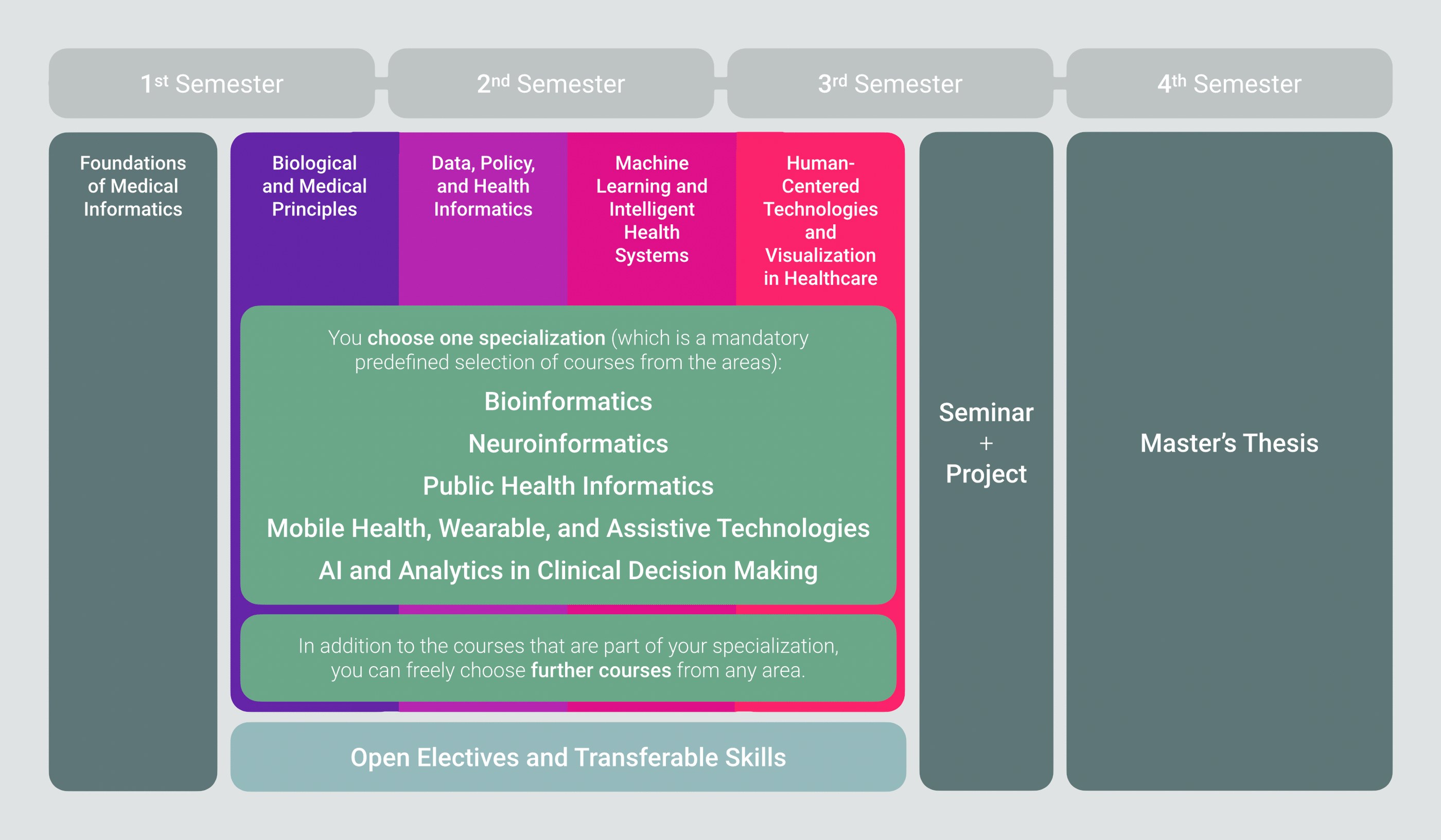
The first semester is dedicated to building the Foundations of Medical Informatics with the modules Advanced Software Engineering in the Biomedical Context, Biological Basis of Disease, Introduction to Medical Data Science and Analytics, and Introduction to Digital Health.
Over the course of the second and third semesters, the program offers courses from different areas: Biological and Medical Principles; Data, Policy, and Health Informatics; Machine Learning and Intelligent Health Systems; Human-Centered Technologies and Visualization in Healthcare. You select one specialization, which combines modules from these areas: Bioinformatics; Neuroinformatics; Public Health Informatics; Mobile Health, Wearable, and Assistive Technologies; or AI and Analytics in Clinical Decision Making. In addition, you can freely choose further modules from all areas. The third semester ist also dedicated to put the theory into practice in a real-world project.
The fourth semester is dedicated to developing and writing your master’s thesis.
Throughout your studies, a well-balanced set of open electives and extension courses deepens your knowledge of core competencies in Medical Informatics and allows you to explore interdisciplinary areas, apply technical and medical concepts in broader contexts, and develop valuable secondary skills.
Environment
You are deeply immersed in a rich environment full of exciting ideas and interesting challenges that foster your talents and provide new experiences:
- Participate in our student mobility programs! International exchange is in our DNA. Meet students, researchers, and lecturers from all over the world, participate in Erasmus, and join our double degree programs during your Masters.
- Show your excellence! With our TU Wien Informatics Awards, we celebrate outstanding student accomplishments at all levels and share them with the entire TU Wien community.
- Come for the Master; stay for the Doctorate! A master’s degree is the ideal preparation for a doctorate at the TU Wien Informatics Doctoral School. And we are always looking for excellent candidates for open positions in the scientific field.
- Get to know the people and research! We are proud of the distinguished scholars and researchers who make up our diverse faculty. Find out who they are, what projects our research units are working on, and stay in touch through our newsroom and social media channels.
- Enjoy Vienna! Our campus is located directly in the heart of Vienna. Besides Vienna ranking as the city with the highest quality of life and TU Wien Informatics in the Global Top 15% in Computer Science, there are numerous more reasons why you should study with us.
Be part of TU Wien Informatics and help us shape the technologies of the future - today!
Frequently Asked Questions
Where can I register?
Do I need a medical background?
How are courses divided between TU Wien and Medical University of Vienna?
What is the difference between mandatory modules (Pflichtmodule), elective modules (Wahlmodule), specializations (Schwerpunkt), and open electives (Freie Wahlfächer)?
Modules are the building blocks of the curriculum. They are the groups of courses you complete to earn your degree. Mandatory modules (Pflichtmodule) provide the common foundation for all students. Elective modules (Wahlmodule) allow you to tailor your studies to your interests by choosing from a broad range of advanced topics.
A specialization (Schwerpunkt) is different: it is a recommended pathway through the elective modules. Every student chooses one specialization and completes at least 24 ECTS within that area.
Open electives (Freie Wahlfächer) are courses that are not bound to the Medical informatics curriculum. You may select courses from other degree programs or disciplines that complement your studies.