
NoctuaNet2 secures €200,000 and advances in Anti-Drone Response Challenge
The funding supports the team from TU Wien in building a robust counter-system that combines AI-driven visual detection with high-speed autonomous drones.
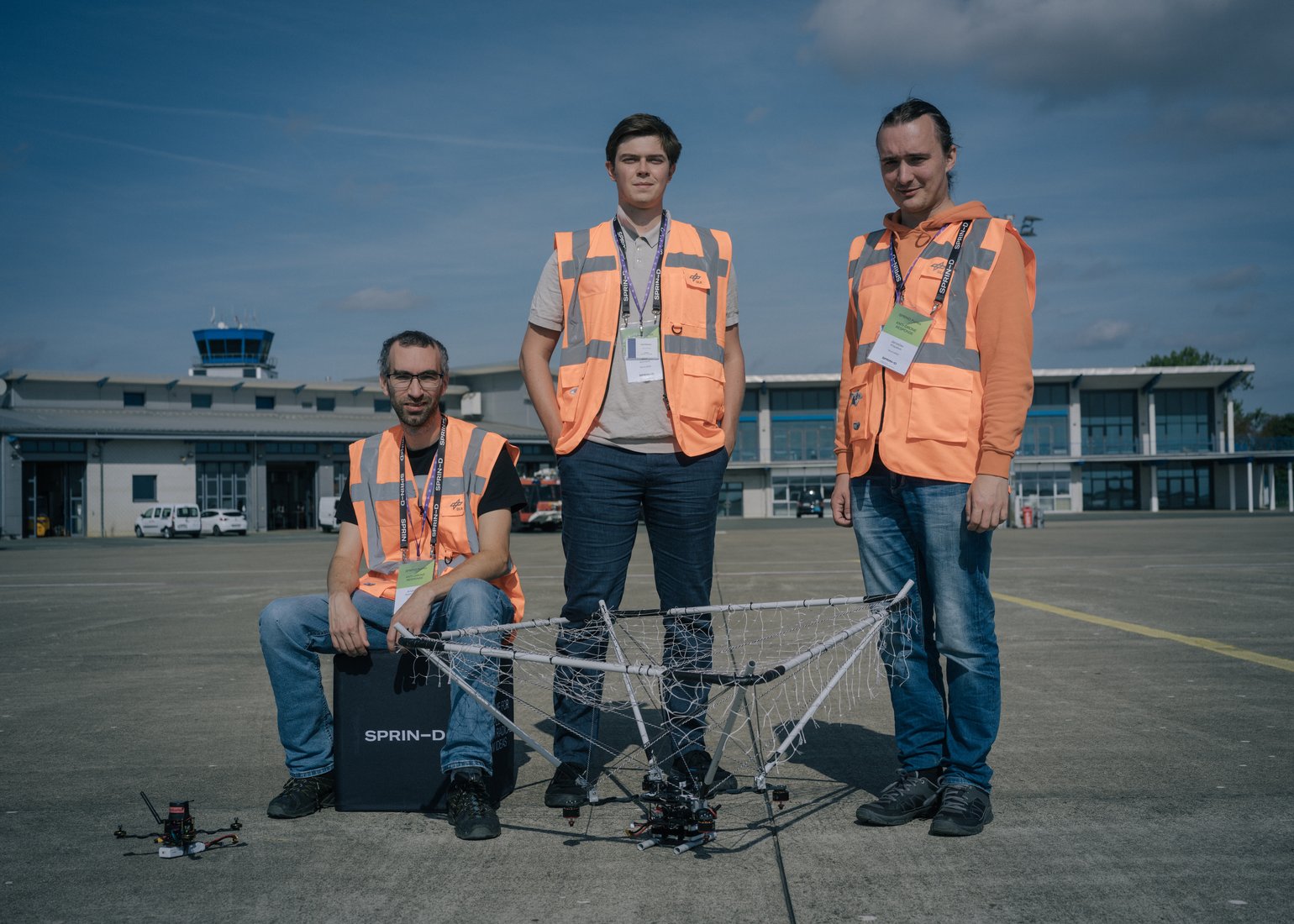
Picture: SPRIND, Felix Adler
Drone activity in urban environments, at airports, and around other critical infrastructure has become a considerable security challenge. For researchers the challenge is twofold: developing reliable ways to identify intruding drones, and ensuring they can be intercepted quickly and safely.
This is precisely what Andreas Brandstätter, Joel Klimont, Jaroslav Klapalek, Felix Resch, and Jakob Buchsteiner from the Research Unit for Cyber-Physical Systems are working on. As part of their participation in the SPRIND “Anti-Drone Response 2.0” challenge, they are building a robust system to counter intruding drones in a non-destructive way. The team from TU Wien Informatics successfully pitched their project, NoctuaNet2, in March 2026. Alongside 15 other teams, they were then selected to advance to Stage 1 of the challenge, securing €100,000 for their research.
With NoctuaNet2, the computer engineers are building an unmanned aircraft system that combines a modular ground sensor network with high-speed autonomous interceptor drones. The ground station uses AI-driven visual detection methods to detect and track intruding drones and to predict their flight paths. Once a drone is detected, high-speed autonomous interceptor drones are deployed to pursue it.
“We focus on fully non-destructive interception methods,” Andreas Brandstätter points out. “Instead of destroying the intruder drone, we capture it mid-air and bring it down safely to the ground. The method comes with its own additional difficulties that we need to address to successfully implement the project.”
Drawing on the team’s experience in autonomous drone racing, the interceptors use agile flight maneuvers to safely entangle and contain intruding drones with a specially engineered, lightweight, and durable net. “Our advantage comes from agile autonomous flight. We build drones and software that can perceive and react under extreme dynamics,” the team explains. “Our software lets us fly […] precisely. Delays of just a few milliseconds can be the difference between losing the target and making a safe intercept.”
Watch on YouTube: https://youtu.be/WaOEdVei7kg
Despite challenging weather conditions at the final demonstration of Stage 1 in June, the team successfully executed multiple autonomous interception maneuvers and thus, met the demanding evaluation criteria. Their successfull demonstration earned the team an additional €100,000 in funding and qualification for Stage 2 of the challenge.
The challenge is conducted by the Federal Agency for Breakthrough Innovation SPRIND in cooperation with the Swedish innovation agency Vinnova and runs for 15 months. Ten teams have the chance to advance to Stage 3, where they can secure up to €300,000 in additional funding.
With another live demonstration ahead, team NoctuaNet2 will now focus on improving the medium and long-range detection capabilities of the AI-driven visual detection methods, as well as the agility of the interceptor drone.
Congratulations to the whole team, and good luck for the next stage of the challenge!
Curious about our other news? Subscribe to our news feed, calendar, or newsletter, or follow us on social media.