
Temporary Hiring Freeze Amid Uncertainty Over Funding
TU Wien Introduces Temporary Hiring Freeze for Global Budget-Funded Positions Amid Uncertainty Over 2028–2030 Funding
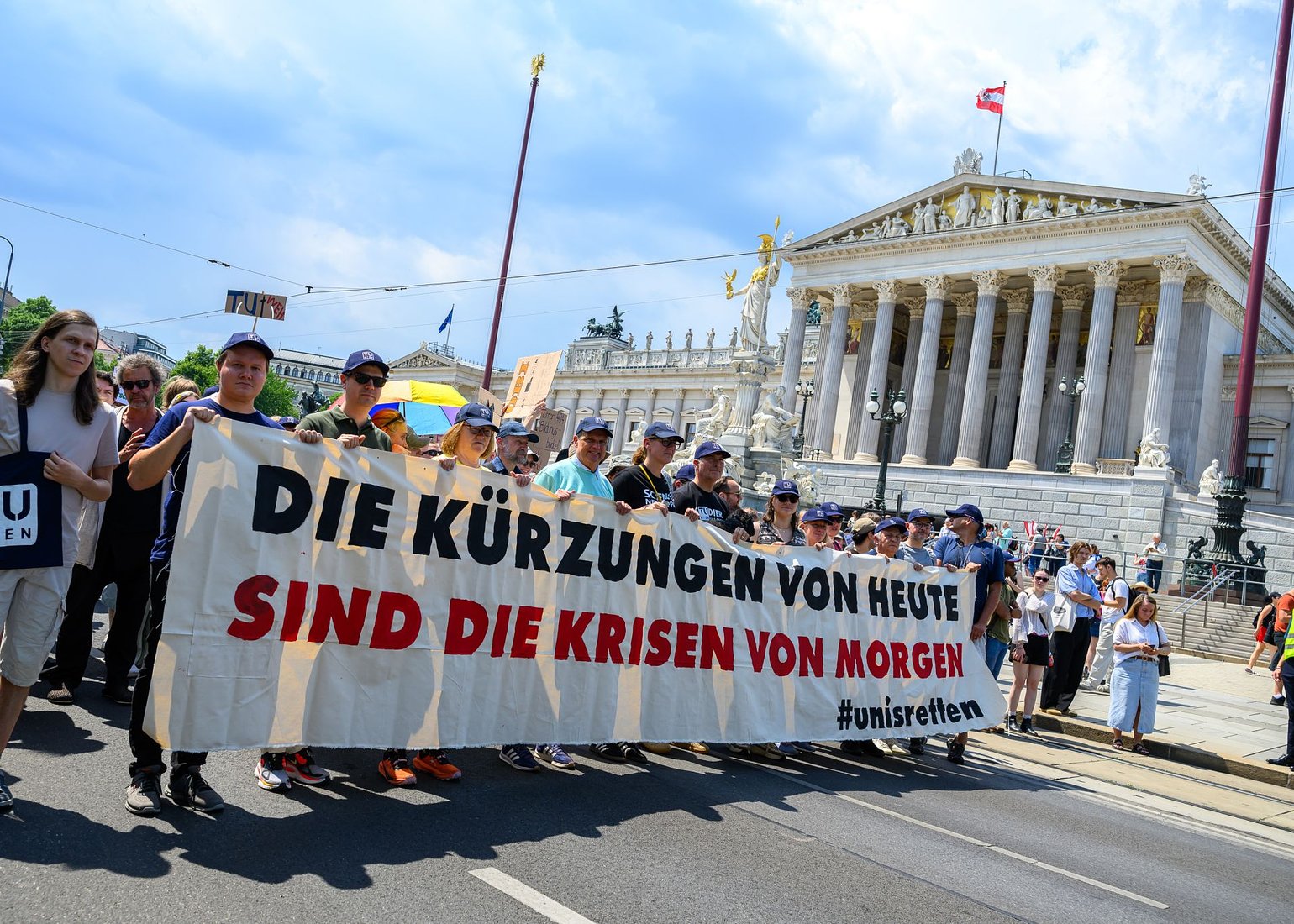
To read the Dean’s statement on the planned budget cuts, please klick on the following link.
At the end of May, the Österreichische Universitätenkonferenz (uniko) was informed that only around €15.5 billion had been designated for all 22 public universities for the next performance agreement period 2028–2030. This is contrasted with an estimated €18 billion that universities, based on inflation forecasts by the Austrian Institute of Economic Research (WIFO), calculate will be needed simply to cover rising operating costs. Science Minister Eva-Maria Holzleitner has since qualified this figure and postponed a final decision until autumn, with no binding funding framework currently available.
It is precisely this uncertainty that has prompted TU Wien to introduce a temporary hiring freeze for positions funded by the global budget.
With an annual global budget of approximately €410 million, cuts of the magnitude currently being discussed would force TU Wien to reduce spending by around €50–60 million per year starting in 2028. A university cannot wait until such cuts actually take effect: faculty appointments, project commitments, and contract extensions for staff are planned years in advance and must be managed with a necessary degree of caution.
“The hiring freeze for positions funded through the global budget is not an act of excessive caution—it is an operational necessity in light of a planning gap that we cannot afford to ignore,” says TU Wien Rector Jens Schneider. “Today, we simply do not know what level of funding we can realistically expect from 2028 onwards. That uncertainty requires us to be extremely cautious with new recruitment for the time being. If the anticipated cuts materialize on the scale currently being discussed, we will have to introduce additional measures to maintain university operations. We also have a responsibility to our staff to respond early and appropriately.”
Early-career researchers would be affected first
Personnel costs account for more than 63% of TU Wien’s budget. Building maintenance and energy costs can only be reduced over the long term, while expenditures on equipment and materials offer nowhere near the savings required. Permanent positions cannot be reduced in the short term. If funding cuts of the proposed magnitude are implemented, the greatest and most immediate impact would fall on early-career researchers, academic staff, and student employees—those who, after years of education and training, take on their first responsibilities in research projects, start building their academic careers, and contribute significantly to teaching and research.
For students, the consequences would include higher student-to-staff ratios and therefore less individual supervision, longer completion times, and higher dropout rates. At the same time, the number of graduates would decline—at precisely the moment when industry and the economy urgently require highly qualified professionals.
Risks for research, innovation, and key technologies
Research performance would also suffer if vacant positions remain vacant; projects would be delayed, collaborations with industry would become more difficult to sustain, and operating research infrastructure—including high-performance computing systems, data centres, and laboratories—requires a sufficient number of qualified staff. Investments already made in research infrastructure would lose much of their value. In recent years, Austria’s universities have streamlined their organisational structures, expanded partnerships with industry, fostered startup ecosystems, and strengthened international networks. Much of this progress would be jeopardized by severe budget cuts during the 2028–2030 funding period.
Particularly affected would be research and development in fields such as artificial intelligence, cybersecurity, sustainability and energy technologies, microelectronics, and information technology. TU Wien has strategically invested in expanding expertise in these key areas to meet growing societal and industrial demand. Stable, internationally connected research teams and academically strong, motivated early-career researchers cannot be built overnight—they are the result of many years of continuous investment. Budget cuts would interrupt this development before it could fully deliver its benefits for innovation, competition, and technological and digital sovereignty.
“If universities lose lecturers, researchers, and young talents, education, research, and economic innovation all come under pressure simultaneously. Cutting university funding means cutting off opportunities for motivated young people and for businesses alike, ultimately undermining Austria’s future,” Schneider says.
Austria’s strength in attracting EU research funding at risk
The proposed national budget cuts are particularly paradoxical in light of developments at the European level: The European Union is planning to substantially increase its research investments. Austrian universities—and TU Wien in particular—are among Europe’s most successful institutions in securing highly competitive EU funding.
The 2025 ERC Advanced Grants, one of Europe’s most prestigious funding programmes, awarded €838 million to 319 leading researchers across 24 countries. Austria alone secured 12 grants.
Such achievements do not happen by chance, they depend on the excellence of research teams, experienced applicants, and long-term support structures—precisely the structures that would be threatened by the proposed funding cuts. Losing experienced early-career researchers and academic staff also means losing the capacity to compete successfully for the expanding European funding programmes.
Read the full article on the TU Wien website (German only).
Curious about our other news? Subscribe to our news feed, calendar, or newsletter, or follow us on social media.