
Jesper Larsson Träff: Lectures on Parallel Computing
We’re delighted to announce the release of Jesper Larsson Träff’s Lectures on Parallel Computing—your guide to mastering Parallel Computing!
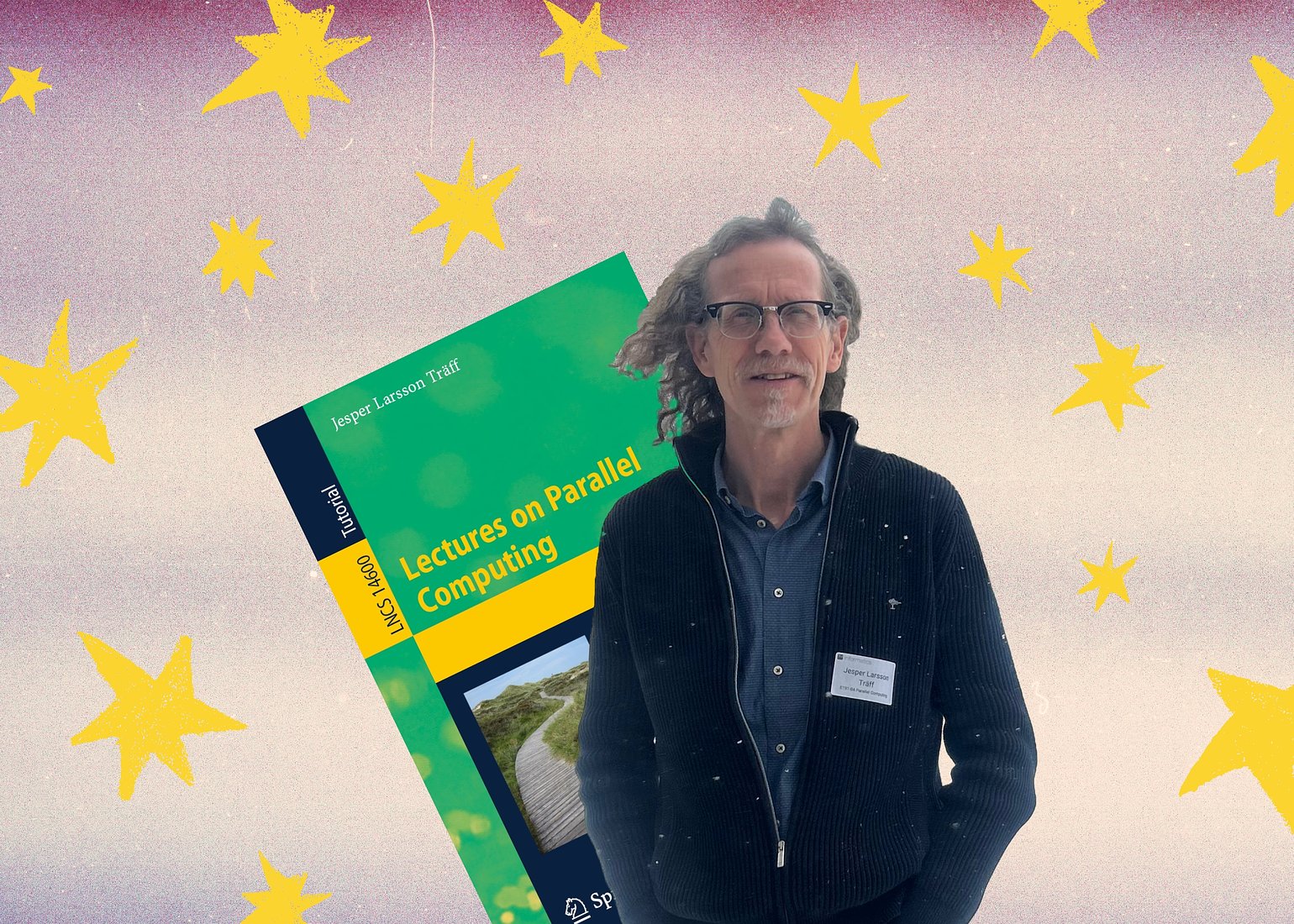
Picture: TU Wien Informatics
Curious to dive into the nitty-gritty of Parallel Computing? Then Jesper Larsson Träff’s book, Lectures on Parallel Computing, is just for you!
This textbook is intended for an undergraduate course on the fundamentals of parallel computing, or as background reading and a reference for graduate courses on high-performance computing, shared-memory multiprocessor programming, or parallel algorithms. Jesper introduces theoretical concepts and tools for expressing, analyzing, and assessing parallel algorithms, and covers in detail the two most widely used concrete frameworks, OpenMP and MPI, plus the threading interface pthreads for writing parallel programs for either shared or distributed memory parallel computers with an emphasis on general concepts and principles. Code examples are given in a C-like style, and the extensive exercises can be used for self-study and as inspiration for small implementation projects in OpenMP and MPI.
The book is well suited for students and professionals engaged in all aspects of parallel computing who are looking for both a clear introduction and a practical reference. You can download the book right here or on the Springer Nature Link Website:
-
PDF / 7.56 MB / Jesper Larsson Träff - Lectures on Parallel Computing.pdf
About
Jesper Larsson Träff is a Professor and Head of the Research Unit Parallel Computing at TU Wien Informatics. From 2010 to 2011, he served as a guest professor for Scientific Computing at the University of Vienna. From 1998 to 2010, he worked at NEC Laboratories Europe in Sankt Augustin, Germany, focusing on efficient implementations of MPI for NEC vector supercomputers; this work led to a doctorate from the University of Copenhagen in 2009. From 1995 to 1998, he spent four years as a PostDoc/Research Associate in the Algorithms Group at the Max Planck Institute for Computer Science in Saarbrücken and in the Efficient Algorithms Group at the Technical University of Munich. He received an MSc in computer science in 1989 and, after two interim years at the industrial research center ECRC in Munich, a PhD in 1995, both from the University of Copenhagen.
Curious about our other news? Subscribe to our news feed, calendar, or newsletter, or follow us on social media.