
The First QIST Graduate Is Here!
We’re excited to celebrate Constantin Nistor, the first graduate of our Master’s program in Quantum Information Science and Technology.
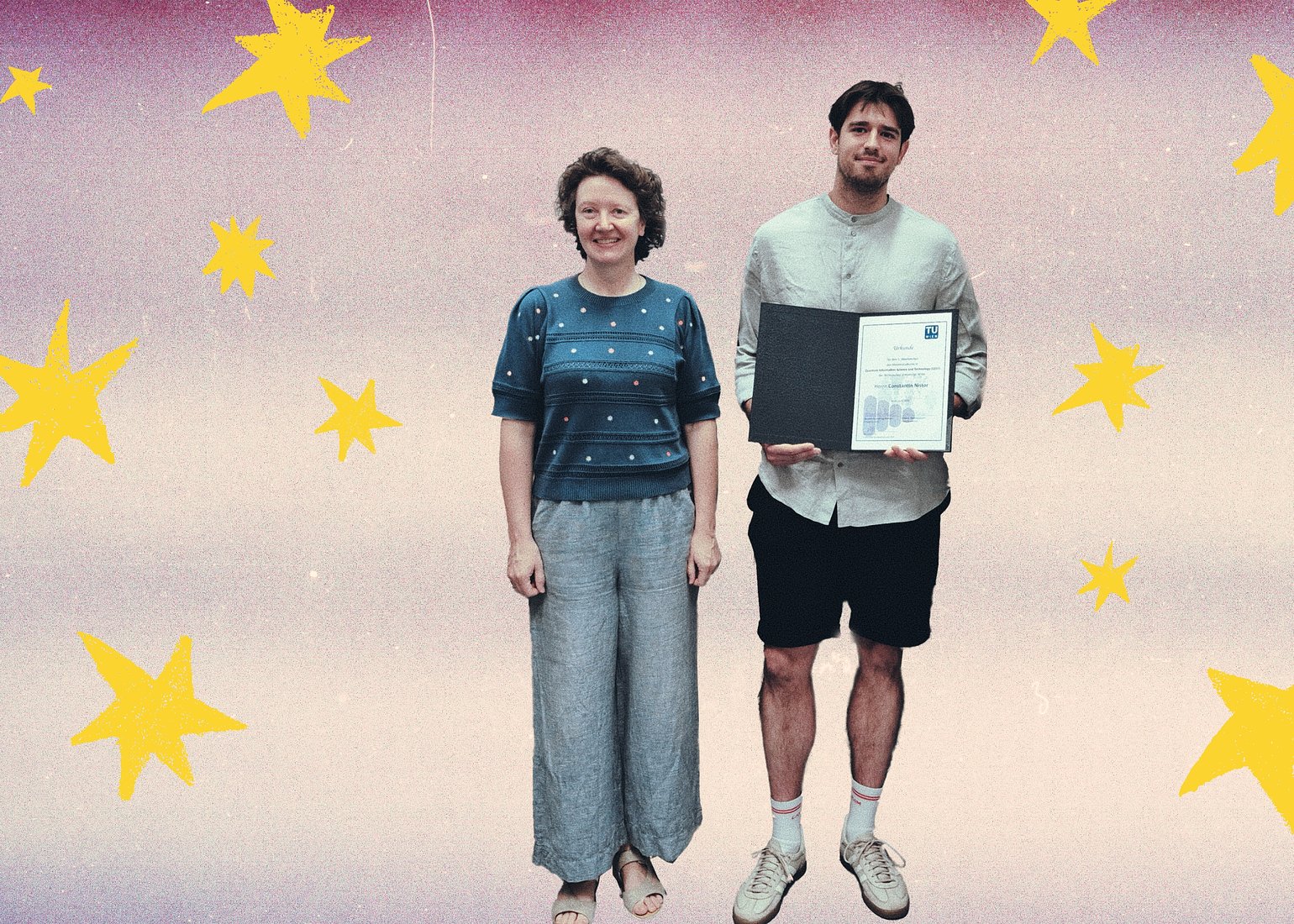
Picture: TU Wien
Quantum technologies have the potential to transform the way we process and communicate information. Our Master’s program Quantum Information Science and Technology (QIST) equips students with the knowledge and skills to explore this emerging field, combining quantum physics, computer science, and engineering.
Constantin’s journey began two years ago alongside 20 other students who enrolled in the Master’s program in an emerging field with the potential to transform computing. At the beginning of this summer, Constantin successfully defended his Master’s thesis, becoming the program’s first graduate. In this interview, he shares insights into the Master’s program, his research, and his plans for the future.
Why did you decide to enroll in the QIST?
When I first heard about the Master’s program, I was working full-time. I had already completed my Bachelor’s in Electrical Engineering and knew I wanted to pursue a Master’s degree. There were a few options available, but none that convinced me 100%. When I found out about QIST, I knew straight away that this was the program I had been waiting for (laughs).
What makes the program so special?
The Master’s program has been designed from scratch; it’s unique, and as far as I know, there’s no other program of its kind. The first semester feels a bit like being back in school as all students attend the same lectures. Later, the program branches out more, depending on the specializations you choose. It focuses on the three main areas of quantum physics, quantum computing, and quantum information sciences. The entire Master’s program is very focused on hands-on experience, and I gained a lot of experience working in applied sciences. For my project thesis, I worked on a practical solution, which I then developed further in my master’s thesis. Over the course of my studies, a real network has developed among the students, and many friendships have formed that I am sure will last beyond the program. It has also become something of a tradition to organize a get-together at the end of each semester to round things off.
Any advice for future students?
Don’t overthink it. If you are interested in quantum physics, don’t be afraid to learn new things; just give it a go. You’ll find lots of like-minded people, have a great time, and, most importantly, realize that it’s much easier to make progress in your studies when you study together and exchange ideas (laughs).
Will you remain at TU Wien now that you have finished your Master’s?
Yes, I’m currently working as an assistant to Ulrich Schmid and Daniel Platz at the Institute of Sensor and Actuator Systems. I’ll be starting my PhD in October and will continue the research I began during my Master’s. I’m really looking forward to it.
Curious about QIST?
Over the past decades, rapid advancements in engineering and computing have transformed how we think about Quantum Physics and Computer Science. This interdisciplinary master’s program, jointly offered by TU Wien’s faculties of Physics, Electrical Engineering and Information Technology, and Informatics, equips students with the skills to tackle real-world challenges in quantum computing, cryptography, and beyond.
Curious about our other news? Subscribe to our news feed, calendar, or newsletter, or follow us on social media.